Thanks to decades of experience and the high level of professionalism of its staff, ASAC Green Gas is able to supply complete turnkey plants for the production of biomethane from any organic matrix with extremely high efficiency and completeCO2 capture.
Thanks to patented ASAC technology, it is possible to build plants producing from 25 to over 1,000Sm3/h of biomethane, powered entirely by difficult biomass such as poultry manure, FORSU, or civil and industrial sludge.
If the customer wishes to build the feed systems, anaerobic digestion systems, and external components independently, it is possible to supply only the patented ASAC hydrolysis system withCO2 upgrading and sequestration.
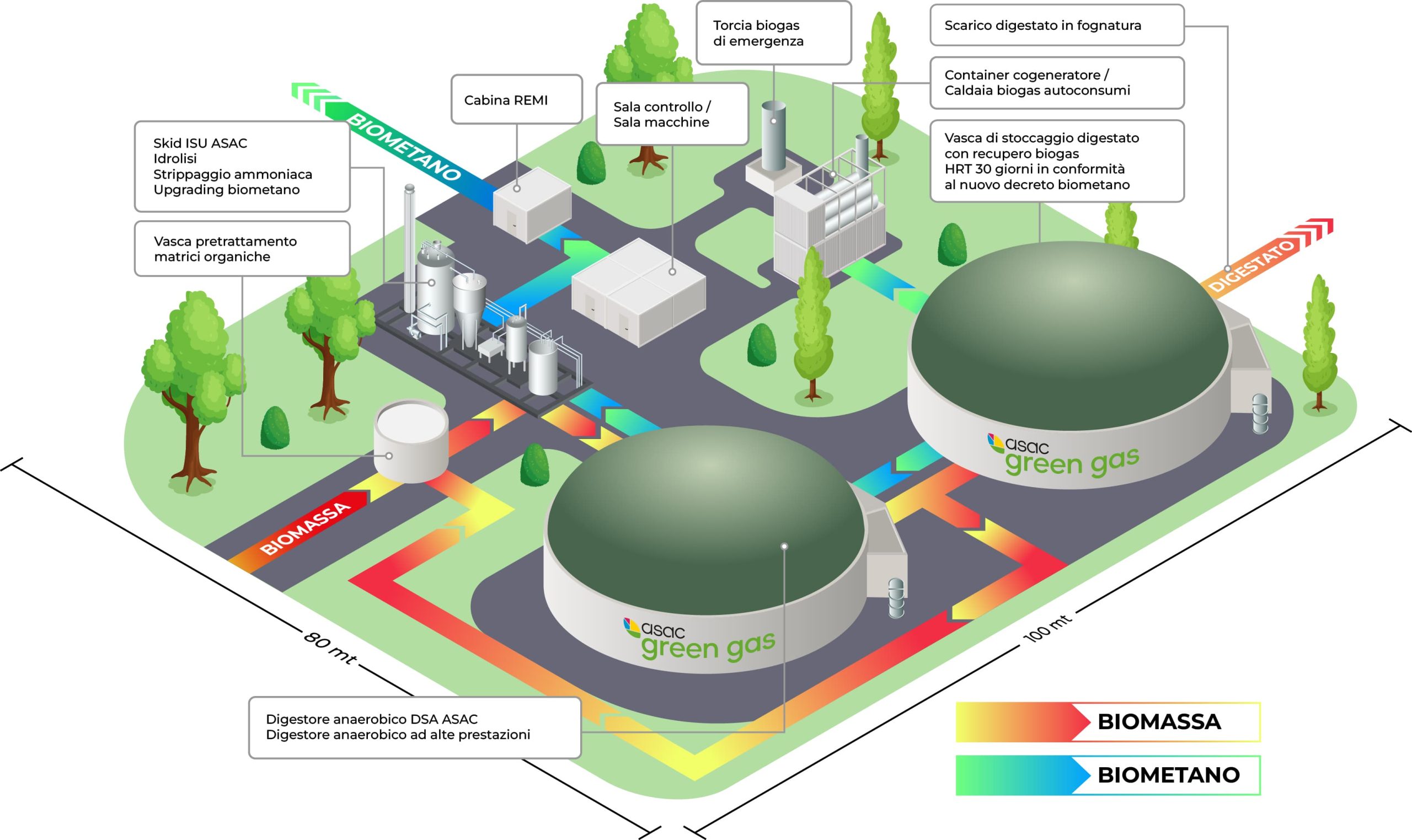
DSA ASAC Anaerobic Digester
After hydrolysis, the sludge is sent to a mesophilic anaerobic digestion phase. Compared to a traditional system,the sludge is much easier to digestbecause, on the one hand, ASAC hydrolysis has solubilized the COD, making it easily available to methanogenic bacteria, and, on the other hand, it has also eliminated all the ammonia, a toxic substance that inhibits anaerobic bacteria. Ultimately, the anaerobic digestion process under these conditions takes place in less time and with greater efficiency, producing a digestate with very low COD, BOD, and nitrogen values that is suitable for direct discharge into the sewer system, after separation of the dry matter by thickening and/or centrifugation or filter pressing. The reduction in the time required for the entire anaerobic digestion process for the greatest possible recovery of biogas can be significantly reduced, especially for difficult biomasses such as poultry manure and FORSU. In addition, the methane residue is reduced to a minimum and, in fact, more gas is produced than with traditional technologies.
Curve
Recirculation system for minimizing water requirements
Cogeneration container
With this technology, anaerobic digestion volumes are extremely low compared to other technologies. This means, in addition to taking up less space, it reduces the thermal and electrical requirements for pumping and mixing. Furthermore, energy-intensive downstream treatments such as composting and nitro-denitro are not necessary. Throughout the process, the biogas remains at atmospheric pressure, avoiding the energy costs of compression, which are necessary in membrane or PSA systems. Self-consumption is easily covered by a small cogenerator, possibly supplemented by a small biogas boiler.
Organic matrix pretreatment tank
In this section, organic matrices are dosed and prepared by fine grinding, preheating with heat recovered from the process, and mixing to obtain a pumpable slurry to be sent to the subsequent sections.
Digestate discharge into the sewer system
The patented ASAC technology allows for the intensive stripping of nitrogen and the complete degradation of organic substances during anaerobic fermentation. As a result, the liquid digestate output is suitable for disposal in the sewer system (Legislative Decree 152/06) through the simple separation of solids and possible passage through a small oxygenation tank. No nitro-denitro treatment sections are required. No spreading of digestate is necessary (the digestate can be discharged into the sewer system).
Biomethane
The patented ASAC technology allows for the production of high-purity biomethane suitable for injection into the grid in compliance with current regulations.
Skyd ISU ASAC
In this section, the sludge is treated using an innovative hydrolysis process developed and patented by ASAC, in which organic substances are solubilized and made more digestible. In addition, nitrogen compounds are converted into gaseous ammonia, which is then recovered in the form of ammonium sulfate through a sulfuric acid scrubber. What is carried out in this phase is not a simple hydrolysis as is usually the case in normal pre-treatment plants, but a hydrolysis specially optimized for ammonia stripping and the solubilization of organic substances, with very high efficiency. In this phase, an initial upgrading step takes place, where a portion ofthe CO2 present in the biogas is absorbed and converted into calcium bicarbonate. At this stage, the process also allows for the complete purificationof H2Sand other unwanted components in the biogas. The final step of the ASAC process is the upgrading and final purification of the biogas into biomethane, which takes place through a second step of convertingCO2 into calcium bicarbonate.
1
After hydrolysis, the sludge is sent to a mesophilic anaerobic digestion phase. Compared to a traditional system, the sludge is much easier to digest because, on the one hand, ASAC hydrolysis has solubilized the COD, making it easily available to methanogenic bacteria, and, on the other hand, it has also eliminated all the ammonia, a toxic substance that inhibits anaerobic bacteria. Ultimately, the anaerobic digestion process under these conditions takes place in less time and with greater efficiency, producing a digestate with very low COD, BOD, and nitrogen values that is suitable for direct discharge into the sewer system, after separation of the dry matter by thickening and/or centrifugation or filter pressing. The reduction in the time required for the entire anaerobic digestion process for the greatest possible recovery of biogas can be significantly reduced, especially for difficult biomasses such as poultry manure and FORSU. In addition, the methane residue is reduced to a minimum and, in fact, more gas is produced than with traditional technologies.
2
Any type of organic matrix, even biomass that is difficult to treat, such as: poultry manure, FORSU, sewage sludge, industrial sludge, waste with a high ammonia content.
3
Recirculation system for minimizing water requirements
4
With this technology, anaerobic digestion volumes are extremely low compared to other technologies. This means, in addition to taking up less space, it reduces the thermal and electrical requirements for pumping and mixing. Furthermore, energy-intensive downstream treatments such as composting and nitro-denitro are not necessary. Throughout the process, the biogas remains at atmospheric pressure, avoiding the energy costs of compression, which are necessary in membrane or PSA systems. Self-consumption is easily covered by a small cogenerator, possibly supplemented by a small biogas boiler.
5
In this section, organic matrices are dosed and prepared by fine grinding, preheating with heat recovered from the process, and mixing to obtain a pumpable slurry to be sent to the subsequent sections.
6
The patented ASAC technology allows for the intensive stripping of nitrogen and the complete degradation of organic substances during anaerobic fermentation. As a result, the liquid digestate output is suitable for disposal in the sewer system (Legislative Decree 152/06) through the simple separation of solids and possible passage through a small oxygenation tank. No nitro-denitro treatment sections are required. No spreading of digestate is necessary (the digestate can be discharged into the sewer system).
7
The patented ASAC technology allows for the production of high-purity biomethane suitable for injection into the grid in compliance with current regulations.
8
In this section, the sludge is treated using an innovative hydrolysis process developed and patented by ASAC, in which organic substances are solubilized and made more digestible. In addition, nitrogen compounds are converted into gaseous ammonia, which is then recovered in the form of ammonium sulfate through a sulfuric acid scrubber. What is carried out in this phase is not a simple hydrolysis as is usually the case in normal pre-treatment plants, but a hydrolysis specially optimized for ammonia stripping and the solubilization of organic substances, with very high efficiency. In this phase, an initial upgrading step takes place, where a portion ofthe CO2 present in the biogas is absorbed and converted into calcium bicarbonate. At this stage, the process also allows for the complete purificationof H2Sand other unwanted components in the biogas. The final step of the ASAC process is the upgrading and final purification of the biogas into biomethane, which takes place through a second step of convertingCO2 into calcium bicarbonate.
A new plant built using patented ASAC technology offers numerous advantages, one of the most important being the ability to build a plant with much lower anaerobic fermentation volumes than traditional technologies. ASAC's special patented hydrolysis phase produces biomass that is much easier for anaerobic bacteria to digest, ensuring much lower retention times inside the anaerobic digesters and complete stripping of ammoniacal nitrogen. As a result, the plant can also be fed with 100% biomass that is generally very difficult to process because it is rich in nitrogen, such as poultry manure, FORSU, or civil or industrial sludge, with extremely reduced digestion volumes.
The digestate also has very low nitrogen concentrations and does not require subsequent composting or nitro-denitro treatments.
All this translates into a much simpler and smaller plant with a very low aesthetic impact, an issue that is particularly sensitive and important to the population, which is often opposed to the construction of biomethane plants precisely because of landscape and environmental issues.
The need for transport, another issue of particular concern to the population, is also minimized, as ASAC technology eliminates the need to spread liquid digestate, which is instead released directly into the sewer system.
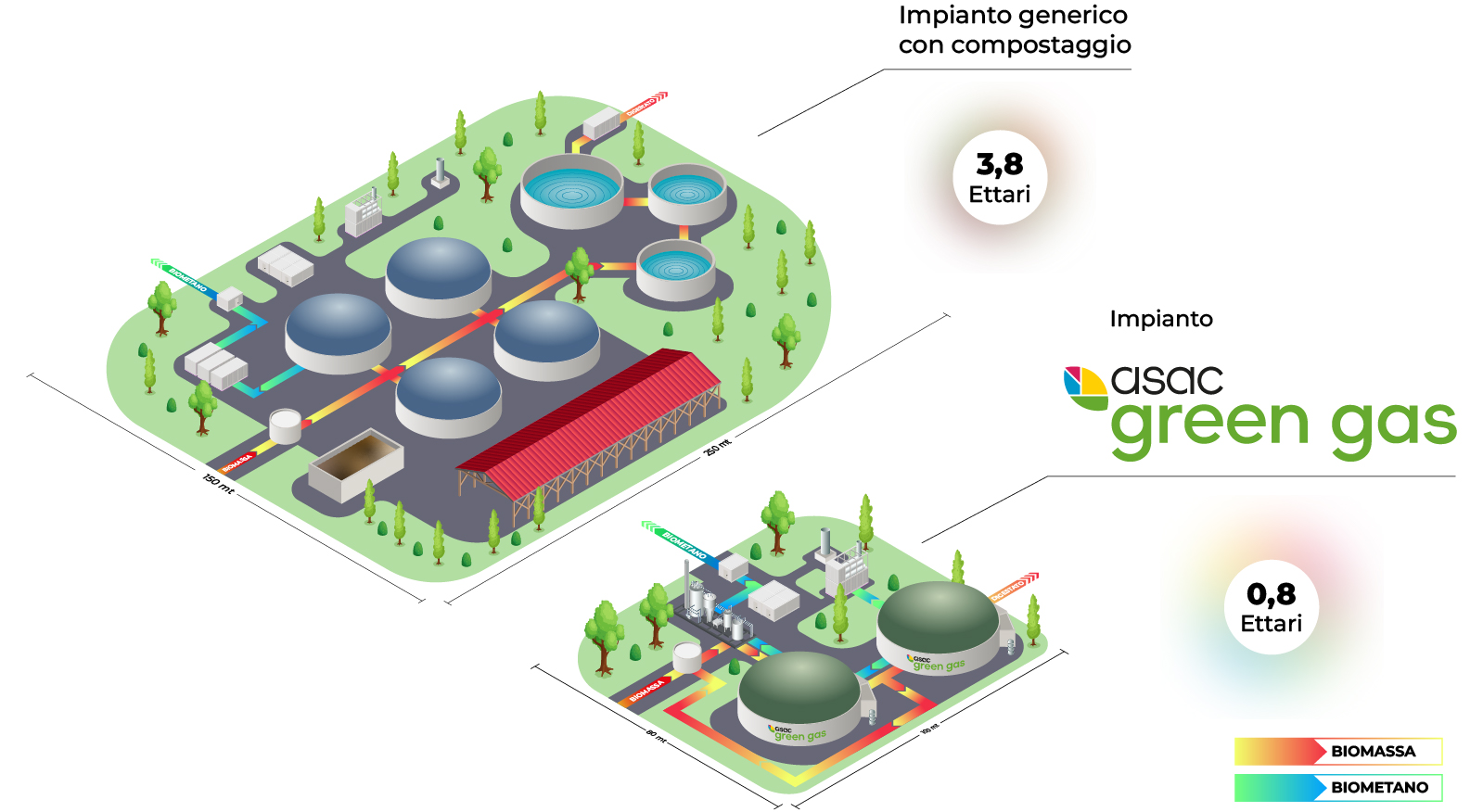
To provide a comparison, here are the dimensions of a 500Sm3/h plant fed 100% with chicken manure, where the installation surface area is much smaller than that required by traditional technologies (membranes, PSA, etc.).
Finally, it should be noted that the patented ASAC system is not a simple upgrading system, but an integrated system whereCO2 is completely captured and converted into bicarbonates, resulting in an extremely low carbon footprint.