INTRODUCTION
Climate change requires us to reduce our consumption of fossil fuels by replacing them with renewable fuels such as biomethane, which will play an increasingly important role in the future, especially if produced in the most sustainable way possible.
Sustainability in biomethane production means developing plants capable of low self-consumption, scalable to small sizes so that they can be built in places where biomass is available locally, optimizing the nitrogen production cycle by minimizing the spreading of digestate and, above all, sequestering theCO2 present in biogas so as not to release climate-changing gases into the atmosphere, obtaining not only a green gas (biomethane) with a zeroCO2 balance, but even a negative balance.
In addition to this, sustainability means creating plants that are well integrated into the local area, with minimal dimensions, no odors, optimized nitrogen flows, and the least possible impact on traffic.
With this in mind, ASAC decided several years ago to focus its efforts on optimizing the biomethane production cycle through a patent that aims to resolve all the issues arising from the anaerobic digestion production process. Specifically:
With this in mind, ASAC decided several years ago to focus its efforts on optimizing the biomethane production cycle through a patent that aims to resolve all the issues arising from the anaerobic digestion production process. Specifically:
- Create a stable anaerobic digestion process that is not subject to imbalances
- Getting the maximum possible yield from the biomass input
- Eliminate emissions into the atmosphere in terms ofCO₂,CH₄,H₂S, and odorous emissions.
- Develop a simple, economical, and scalable upgrading process that can also be applied to small sizes.
- Rationalize nitrogen flow by minimizing the amount of digestate that needs to be spread
- Significantly reduce anaerobic digestion volumes by making the plant as small and low-impact as possible.
- Totally sequesterCO2 by converting it into bicarbonate with a double positive effect: further reduction of a greenhouse gas and the absence of complex post-combustion systems for off-gas.
Following the acquisition of a specific, highly innovative patent for the production of biomethane, ASAC has built a semi-industrial pilot plant that allows certain types of waste to be treated, ensuring the production of methane withoutCO2 emissions (CO2 sequestration with an extremely low carbon footprint). In particular, the pilot plant is authorized pursuant to Art. 211 of Legislative Decree 152/06 and subsequent amendments and additions for the following codes: EER 02.03.00, 19.08.05, 19.08.05, 20.01.08, 20.02.01, 20.03.02 and has a capacity of 4 tons/day.
The plant solution proposed in the aforementioned patent offers the following advantages:
- The process can be applied to existing biogas plants by converting them to biomethane production.
- The process can be applied to newly constructed plants;
Production of biomethane withoutCO2 emissions
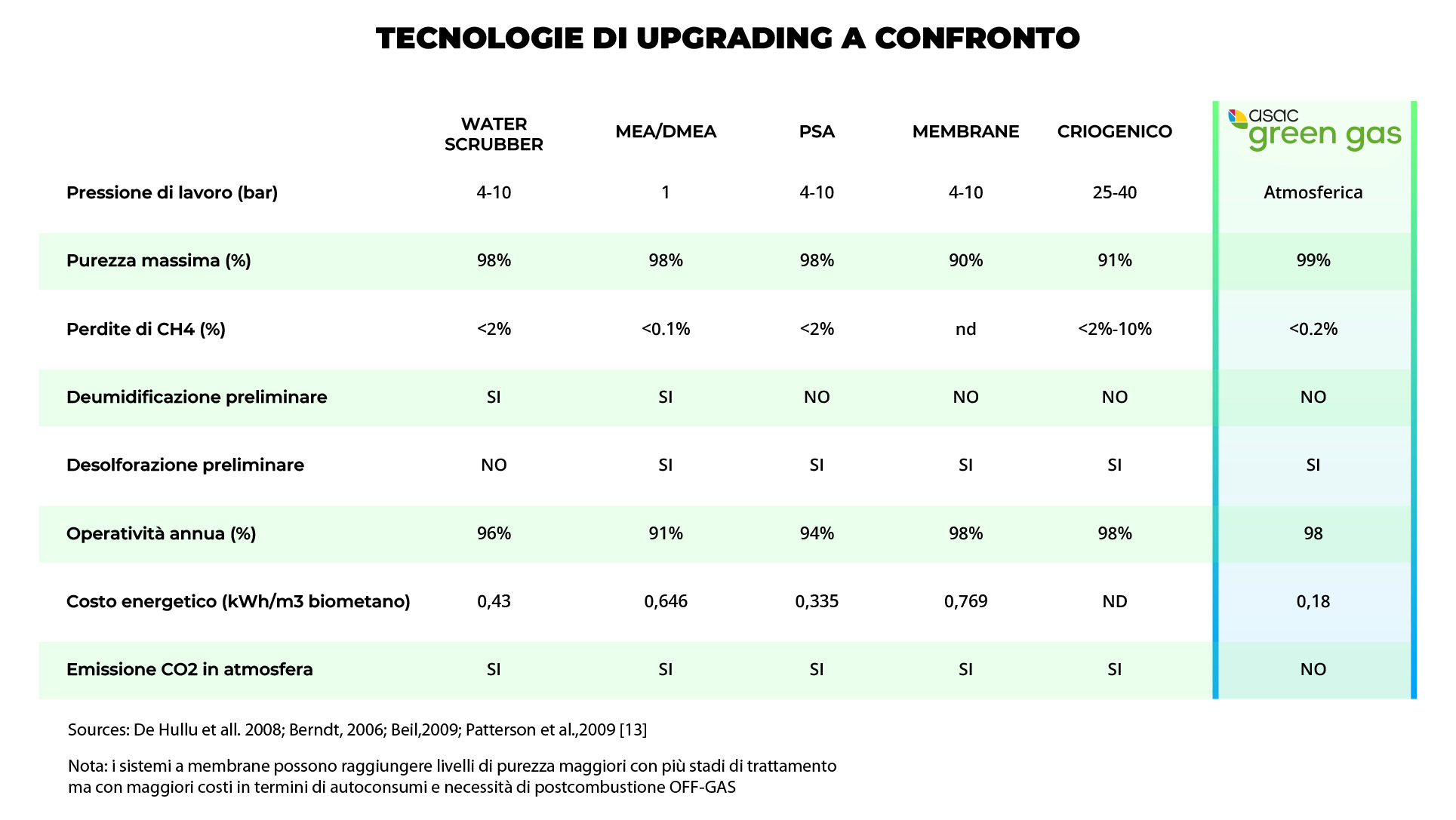
This advantage cannot be achieved with other available technologies (molecular sieves, absorption with amines, or cryogenic condensation) unless complex catalytic synthesis processes powered by green hydrogen (electrolytic from photovoltaic systems) are used. In this regard, it should be noted that the use ofCO2 for industrial purposes (technical gas) or, even more so, for food applications, is unlikely given the quantities involved and the absence of a certain and continuous demand from the market. Carbon dioxide has been the greenhouse gas par excellence for 70 years now. Solutions involving underground storage are not currently applicable in our country due to the high margins of uncertainty of the systems.
GENERAL DESCRIPTION OF THE PLANT AND OPERATING DATA
The ASAC pilot plant consists of a feed section where the biomass is introduced, diluted with recirculating water, and adequately homogenized to obtain a pumpable slurry at the desired dry concentration.
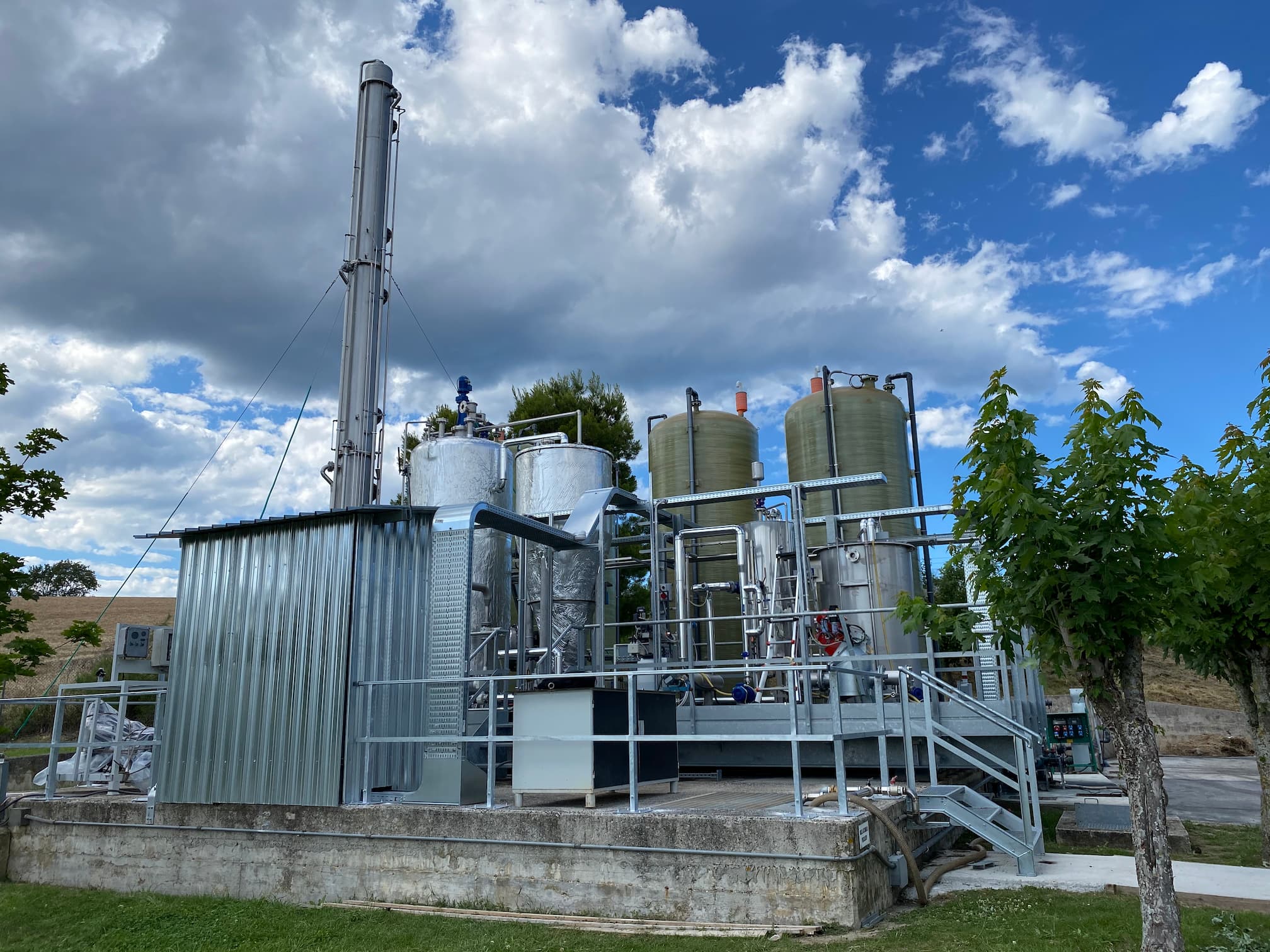
This sludge is sent to the hydrolysis section, where it undergoes a thermochemical treatment that allows the more complex organic substance to be transformed into simpler molecules solubilized in the sludge, thus creating sludge in ideal conditions to be readily available for the bacteria that perform anaerobic digestion, producing high-quality biogas that is very rich in methane.
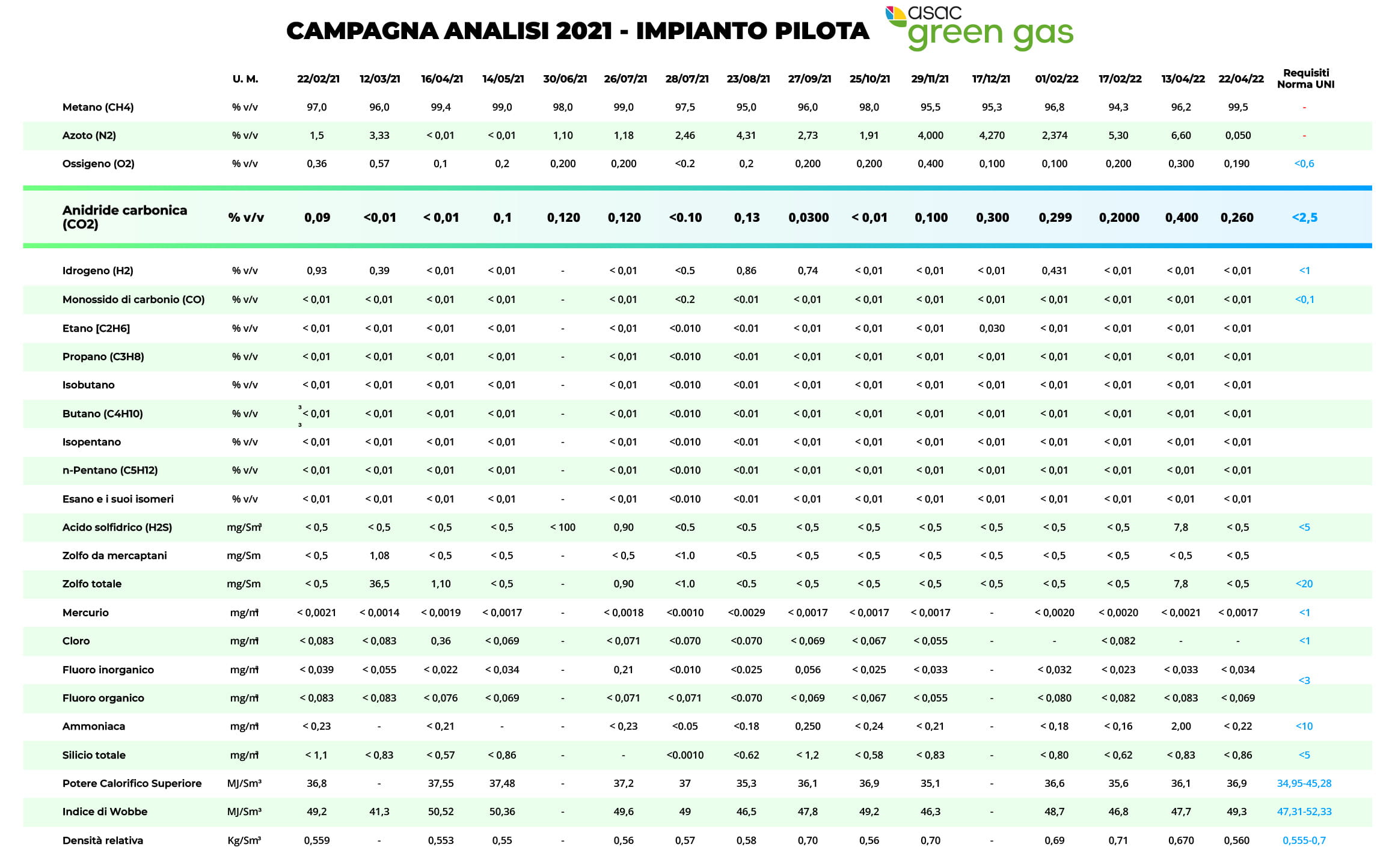
La fase successiva del Il brevetto ASAC si compone di un sistema di conversione della CO2 presente nel biogas in bicarbonato. Il processo include uno scrubber acido per la rimozione dell’ammonica strippata durante la fase di idrolisi convertendola in solfato di ammonio e dei composti solforati residui, in definitiva si ottiene del biometano purissimo, idoneo all’immissione in rete e all’utilizzo come biocarburante presentando valori di CH4 superiori al 96-97% e CO2<0,1% contro il 2,5% minimo richiesto da norma UNI.
The pilot plant is not connected to the gas network, so in this case the biomethane is compressed inside a series of cylinders that feed an endothermic engine operating in island mode.
The pilot plant has been operating for more than two years, with a capacity of 4 tons/day of biomass input. Over these two years, it has mainly treated sewage sludge, but also particularly difficult biomass such as poultry manure and wet municipal waste.
The operation proved to be exceptional, as it was possible to verify that all the set objectives could be achieved with a simple but particularly intelligent system, especially in the biomass hydrolysis andCO2 absorption section. In particular, the effects of the patented hydrolysis process include not only optimal pre-treatment of the organic substance, which facilitates anaerobic digestion and reduces processing times, but also the stripping of all excess ammoniacal nitrogen and, at the same time, the absorption ofCO2 andH2Sin a simple and completely reliable manner.
CONCLUSIONS
During the two years of experimentation, the strengths of the patent were demonstrated, namely the production of high-quality biomethane suitable for injection into the grid and the total capture of CO2 produced by anaerobic digestion, thus preventing any emissions into the atmosphere.
This means that there is no need for post-combustion of gaseousCO₂, as occurs in membrane systems, which can have significantCH₄ leaks.
The trial also made it possible to verify the ease of operation of the plant, which, first and foremost, operates at atmospheric pressure unlike other biomethane upgrading technologies, and therefore presents itself as a safe and reliable system, with no leaks from the pipes, and as a simple system, with no particularly complex sections and/or requiring special maintenance.
Self-consumption is extremely low, and biomass pretreated with the special ASAC hydrolysis phase proved to be much easier and faster to treat, allowing for the construction of digesters that are much smaller than those used with traditional technologies.
The entire system is characterized by extreme simplicity of installation and requires very little space. It is also easily scalable, adapting well to both large-scale biogas production plants and small-scale plants.
Furthermore, by removingCO2 from the biogas stream and fixing it in the aqueous phase as bicarbonate, the ASAC process ensures greater stability for the anaerobic digestion system, guaranteeing a high buffering capacity that prevents any imbalances in the biological reactions involved in converting biomass intoCH4.
The digestate produced is easy to manage as it has undergone a significant reduction in organic matter and the removal of ammoniacal nitrogen, resulting in values suitable for direct discharge into the sewer system without the need for final composting.